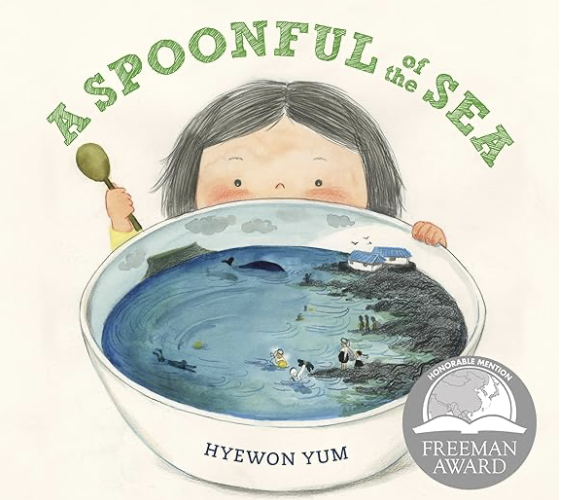

beawerner@bookwyrm.social reviewed A Spoonful of the Sea by Hyewon Yum
Module 3 Diversity in US Published Lit
4 stars
I found the book “A Spoonful of the Sea” by Hyewon Yum through an online search after exploring options on Wakelet. It was published in 2025 and has received many starred reviews and awards, including The 2025 Freeman Book Award Children’s Honor and Rise: A Feminine Book Project (2026). “A Spoonful of the Sea” is about a young girl celebrating her birthday, but instead of having her favorite cake, her mother makes seaweed soup. Naturally, she is unhappy about this, describing the soup as smelly and looking like sea water. While she tries to eat it, her mother tells a story about how her mother made her this soup for many days after she was born, and that her grandmother did the same - and so on for many generations - and it became a beloved tradition. After listening to the story, she embraces her birthday soup, and feels nourished …
I found the book “A Spoonful of the Sea” by Hyewon Yum through an online search after exploring options on Wakelet. It was published in 2025 and has received many starred reviews and awards, including The 2025 Freeman Book Award Children’s Honor and Rise: A Feminine Book Project (2026). “A Spoonful of the Sea” is about a young girl celebrating her birthday, but instead of having her favorite cake, her mother makes seaweed soup. Naturally, she is unhappy about this, describing the soup as smelly and looking like sea water. While she tries to eat it, her mother tells a story about how her mother made her this soup for many days after she was born, and that her grandmother did the same - and so on for many generations - and it became a beloved tradition. After listening to the story, she embraces her birthday soup, and feels nourished by it and the love of her mother and grandmothers.
“A Spoonful of the Sea” explores themes of mother/daughter relationships and motherhood, Korean culture, and the environment. It can be considered realistic fiction, and also nonfiction narrative, as the girl’s mother in the story explains that the tradition of eating seaweed soup came about because of women’s roles as sea divers, searching for food for their families. The author Hyewon Yum uses several literary devices to advance the narrative, beginning with words that are literal descriptions, such as the soup “smells briny” and “tastes like the sea”. As the girl begins to appreciate the story behind her birthday soup, the author uses its Korean name, miyeok-guk, and sensory imagery and simile - “smells like grandma’s town, tastes like a birthday” - to describe it. The author also illustrates the pages, using watercolor and a combination of vibrant and muted colors of the earth: blues, greens, yellows, and browns to help convey feelings of warmth and love.
I would recommend this book for grades K-4, as a read aloud for K-2 and an independent read for grades 3-4. It is well suited in literacy instruction to teach descriptive adjectives, simile, and metaphor. Students can discuss how the use of simile and metaphor elevate descriptive language by comparing the descriptive words used at the beginning and end of the story. It can also be used as a cross curricular component to complement science units on animals, plants, and the environment. Students can research how plants nourish animals and people alike, or the environmental impact of damaging animals’ ecosystems.